How to Start an RCFE in California: Complete Licensing & Startup Guide
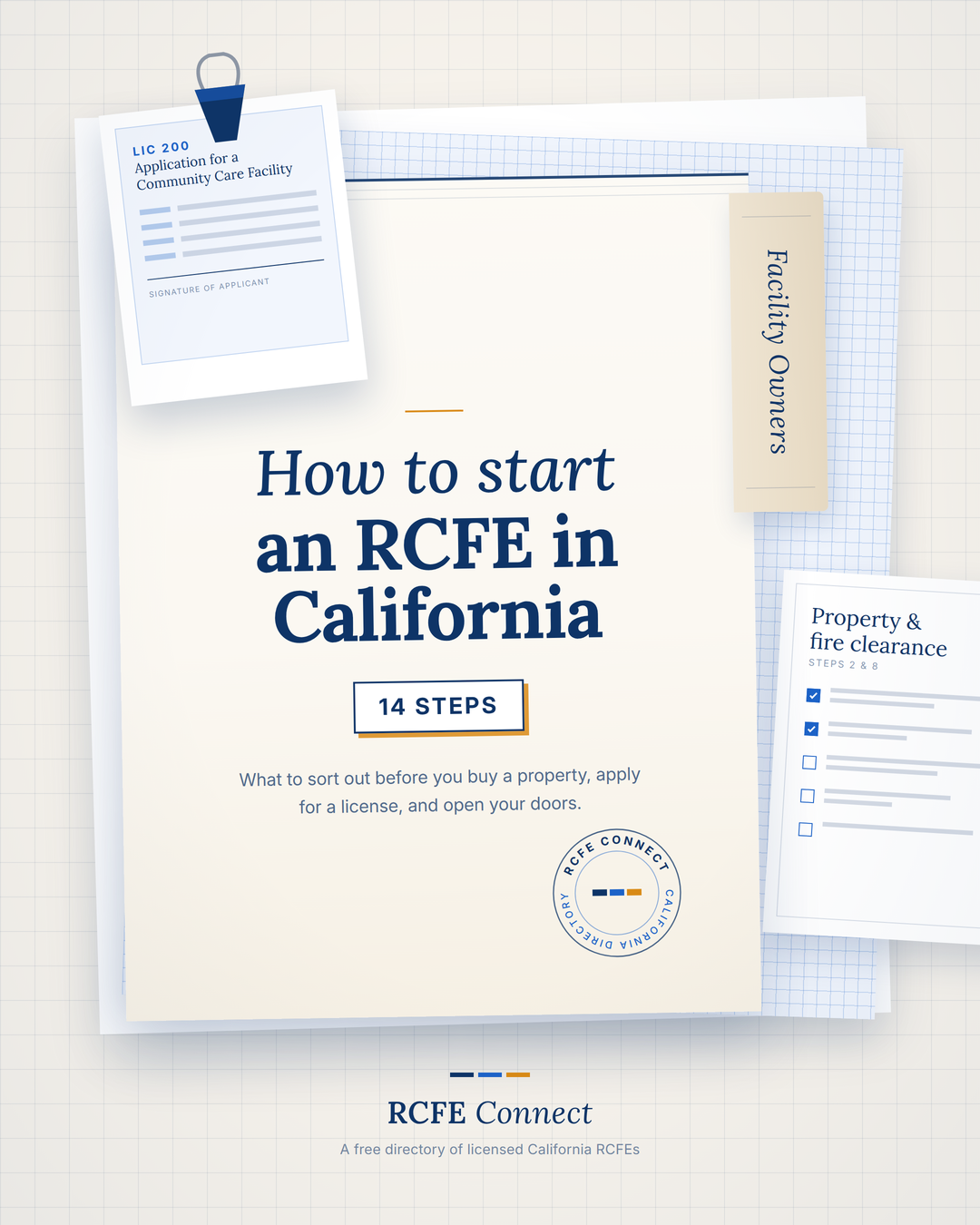
Thinking about opening an RCFE in California? It can be a rewarding business opportunity, but there’s more to it than buying a house and welcoming residents.
From licensing and choosing the right facility to preparing your property and passing inspection, there are several steps to get started.Here’s what you need to know.
Before You Start: Understand What You're Getting Into
Opening an RCFE involves more than obtaining a license.
As an owner or operator, you'll need to think about:
The type and size of facility you want to operate
Your target residents
Your property
Staffing
Care and supervision
Licensing and compliance
Insurance
Operating expenses
Resident admissions
Marketing and occupancy
In other words, getting licensed is only the beginning.
Before spending money on a property, take time to understand the business model you want to build.
Step 1: Decide What Kind of RCFE You Want to Open
Your first decision is determining what your facility will look like.
How many residents will you serve?
You might be considering a small board-and-care home or a larger residential care facility.
Your planned capacity can affect the property's requirements, staffing, fire clearance, and other parts of the licensing process.
Who will you serve?
Think about the population you intend to care for.
For example, will your residents generally be:
Independent older adults who need supervision?
Residents who need help with activities of daily living?
Residents with dementia or Alzheimer's disease?
Residents with more significant care needs?
The type of residents you plan to serve can affect the requirements for your facility and staff.
Will you operate the facility yourself?
You may plan to manage the facility yourself, or you may hire a qualified administrator.
This is an important distinction because owning an RCFE and being its certified administrator are not necessarily the same thing.
Step 2: Find a Property That Can Support Your RCFE
Once you have a basic idea of your facility, you'll need a suitable property.
But here's an important warning:
Don't buy or lease a property simply because it looks like a good house for an RCFE. Make sure it can actually support the facility you intend to operate.
Before committing to a property, investigate requirements that may affect your plans, including:
Local zoning
Land-use requirements
Building requirements
Fire safety
Accessibility
Number of bedrooms and bathrooms
Resident capacity
Exits and evacuation routes
Local permits or approvals
Some projects may also involve local planning or conditional-use requirements.
Your local jurisdiction and the California licensing authority should be consulted before you make a major property commitment.
The property should work for your RCFE plan and not the other way around.
Step 3: Complete the Required RCFE Orientation
Before moving through the licensing process, prospective RCFE applicants need to complete the required orientation.
California's current Adult and Senior Care Program uses a three-component process for new licensees:
Component I: Application Orientation
This is currently completed online for RCFE applicants.
The current CDSS guidance lists a $50 orientation fee plus a $4.85 processing fee, for a total of $54.85. The orientation is non-refundable and non-transferable.
Component II: Application Interview
After the application is submitted and reviewed, the applicant participates in an interview with the reviewing analyst.
Component III: Operations and Record-Keeping Orientation
This is completed later in the licensing process and is designed to help new licensees understand important operational and record-keeping responsibilities. CDSS states that this component occurs after the pre-licensing inspection.
Don't confuse the applicant orientation with administrator certification. They are separate requirements.
Step 4: Become a Certified RCFE Administratoror Hire One
An RCFE must have a qualified administrator.
If you want to become the administrator yourself, California has a specific certification process.
For a standard RCFE administrator applicant, CDSS currently requires:
Initial Certification Training Program (ICTP)
Administrator Certification Examination
Criminal record clearance
Administrator certification application
The current RCFE ICTP requirement is 80 hours, of which 20 hours may be completed through the self-paced format.
After completing the ICTP, the applicant must take and pass the administrator examination within 60 days, with up to three attempts. The current exam has 100 questions, a 120-minute time limit, and requires a score of at least 70% to pass.
After passing, the administrator certification application must be submitted within 30 days of receiving notification of the passing result.
The current initial administrator certification application processing fee is $140.
What if you don't want to be the administrator?
You can explore hiring someone who meets California's administrator requirements.
Either way, make sure you understand who will actually be responsible for managing the facility's day-to-day operations and compliance.
Step 5: Complete Required Background Checks
People who are required to obtain criminal record clearance must complete the appropriate background-check process.
For administrator certification, CDSS requires criminal record clearance, and applicants generally use the LIC 9163 Live Scan form as part of the process.
Depending on the individual's circumstances, a criminal record exemption may be required.
This is one reason you should start the background-clearance process early rather than waiting until the end.
Step 6: Prepare Your RCFE Application
Now comes the actual facility licensing application.
The application process requires more than simply submitting one form.
The core application is the LIC 200 – Application for a Community Care Facility or Family Child Care Home, along with supporting documentation applicable to your facility.
CDSS's application checklist identifies items such as:
Orientation documentation
A facility sketch
Emergency Disaster Plan
Financial information
Administrator qualifications
Organizational documents, where applicable
Other facility-specific supporting documents
Your exact application packet depends on your facility and circumstances.
Keep a copy of everything.
CDSS specifically advises applicants to retain copies of their application documents for their records.
Step 7: Prepare Your Financial Information
California doesn't just want to know whether you have a property.
You also need to demonstrate that you have the financial resources to operate the facility.
CDSS identifies financial verification to ensure sufficient start-up funds as part of the licensing review.
Your financial planning should account for more than licensing fees.
Consider:
Property purchase or lease
Renovations
Fire and safety improvements
Licensing fees
Administrator training
Insurance
Furniture and equipment
Food
Utilities
Payroll
Supplies
Marketing
Operating reserves
Don't budget only for opening day.
A new RCFE may need time to reach stable occupancy, so having sufficient operating funds is important.
Step 8: Get Your Property Ready for Fire Clearance
Fire safety is a major part of the RCFE licensing process.
The licensing process involves coordination with the appropriate local fire authority, and CDSS requires applicants to identify the local fire authority so that a fire clearance can be obtained.
Depending on your facility, fire-safety requirements can involve things such as:
Fire alarms
Emergency exits
Fire extinguishers
Evacuation routes
Emergency lighting
Building modifications
Resident mobility considerations
The exact requirements depend on the facility and its circumstances.
One of the biggest mistakes you can make:
Waiting until after you commit to a property to find out what fire-safety work it needs.
Before purchasing or leasing a property, investigate what will be required to make it suitable for the RCFE you plan to operate.
Step 9: Prepare the Facility
Once your property and licensing requirements are understood, you'll need to prepare the actual facility.
Think beyond making the house look nice.
Your facility needs to be ready to safely support residents and operate according to California's requirements.
This can include preparing:
Resident areas
Bedrooms
Bathrooms
Common areas
Dining areas
Outdoor areas
Safety
Emergency equipment
Evacuation procedures
Safety supplies
Required signage
Operations
Resident records
Staff records
Policies and procedures
Medication-related procedures
Emergency plans
Infection-control practices
Staffing
Job descriptions
Personnel files
Required training
Background clearances
Staffing schedules
The exact requirements depend on your facility, resident population, and applicable regulations.
Step 10: Submit Your Application
Once your application packet and facility are ready, submit your materials according to the current CDSS process.
Before submitting, double-check that:
Your forms are complete
Required signatures are included
Required supporting documents are attached
Your administrator documentation is ready
Your financial information is complete
Required background clearances are addressed
Your facility information is accurate
Required fees are included
An incomplete application can lead to delays.
A good rule:
Don't rush to submit. Submit when you're actually ready.
CDSS advises applicants to make sure the facility is ready for licensure, including having construction completed, start-up funds secured, and applicable local approvals obtained.
Step 11: Complete the Pre-Licensing Inspection
Before receiving your license, your facility will undergo a pre-licensing inspection.
This is where the licensing process moves from paperwork to the actual facility.
The licensing analyst may review whether your facility is prepared to operate and whether it meets applicable requirements.
Before the inspection, make sure you have:
Completed required construction or renovations
Addressed fire-safety requirements
Organized required records
Prepared policies and procedures
Prepared personnel documentation
Prepared emergency procedures
Ensured the physical facility is ready
Think of the inspection as:
"Is this facility actually ready to care for residents?"
Step 12: Complete the Final Licensing Components
Getting through the inspection isn't necessarily the end of the process.
For new applicants, CDSS's current process includes Component III, the operations and record-keeping orientation, after the pre-licensing inspection.
This is intended to help new licensees understand how to operate the facility and maintain required records.
Once the licensing requirements have been satisfied, the facility can move toward becoming an operating RCFE.
Step 13: Get Ready to Actually Run the Business
Here's something many first-time owners don't think about:
Getting licensed and running an RCFE are two different challenges.
Once you're licensed, you'll need to manage:
Residents
Admissions
Assessments
Care and supervision
Resident records
Family communication
Employees
Hiring
Training
Scheduling
Personnel records
Ongoing supervision
Compliance
Required documentation
Inspections
Incident reporting
Emergency procedures
Record keeping
Ongoing regulatory requirements
Business operations
Payroll
Food
Utilities
Insurance
Supplies
Maintenance
Occupancy
Marketing
Your responsibilities don't end when the license arrives.
Step 14: How Will Families Find Your RCFE?
Once your facility is ready to accept residents, you have another important challenge:
Getting found.
A beautiful facility with a great care team won't help families if they don't know you exist.
RCFE owners may rely on:
Referrals
Word of mouth
Community relationships
Placement agencies
Social media
Online searches
Facility directories
But today's families increasingly begin their search online.
That's why making your facility discoverable is an important part of operating an RCFE.
Once your RCFE is ready to welcome residents, you need families to be able to find you.
RCFE Connect helps connect California families searching for senior care with residential care facilities like yours.
Ready to get your RCFE discovered?
List Your Facility on RCFE Connect
Important Compliance Note
This guide is intended as a general overview and is not legal or regulatory advice. California RCFE requirements can change, and requirements may vary based on your facility, location, capacity, resident population, and circumstances.
Before purchasing or leasing property, submitting an application, or beginning operations, verify the current requirements with the California Department of Social Services, Community Care Licensing Division, and the appropriate local authorities.
Official resources:
California Department of Social Services Adult & Senior Care Program
California Community Care Licensing Division
California RCFE Administrator Certification Program
Your local city/county planning authority
Your local fire authority
Comments
Sign in with a family account to join the conversation.
Loading comments…